Why does Japan feel so different from every other country? Why do people bow instead of shake hands? Why is rice sacred? Why are there 80,000 shrines? Why does a tiny island nation have the world’s third-largest economy, the safest cities, and food that makes grown adults weep?
The answers are all in the history. And the remarkable thing about Japan is that you can still see every layer of that history — not in museums, but in living cities, active shrines, and real traditions that have survived for centuries.
This is the story of how Japan became Japan.
The Beginning: Myths and Gods (神話の時代)
What Happened
According to Japanese mythology, the gods Izanagi and Izanami stood on the Bridge of Heaven and stirred the ocean with a jeweled spear. The drops that fell became the islands of Japan. Their children became the gods of wind, fire, sea, and mountains. Their granddaughter, Amaterasu — the Sun Goddess — became the supreme deity of Shinto, and her descendants became the Imperial family.
This is not ancient history buried in textbooks. Shinto is still Japan’s living spiritual practice. Every shrine you visit, every torii gate you pass through, every festival you witness traces back to these creation myths.
Why It Matters for Travelers
The idea that Japan’s islands were created by gods gave the Japanese a deep spiritual connection to their land. Mountains are sacred. Rivers have spirits. Forests are homes of deities. This is why Japan has 80,000 shrines scattered across every mountain, river, and forest — each one honoring the divine nature of the place itself.
Where to See It
- Ise Jingu (Mie) — The holiest Shinto shrine, dedicated to Amaterasu. Rebuilt every 20 years using ancient techniques. The atmosphere of the inner shrine is unlike anywhere else
- Izumo Taisha (Shimane) — Where the gods gather every October. One of the oldest and most mythologically important shrines
- Takachiho (Miyazaki) — The gorge where the gods descended to earth. Dramatic waterfall in a volcanic gorge
The Island Effect: Why Japan Is Different
Before diving into chronological history, understanding geography explains almost everything about Japanese culture.
An Island Nation (島国 — Shimaguni)
Japan is an archipelago of 6,852 islands, separated from the Asian mainland by 200km of ocean. This isolation shaped the civilization profoundly:
What isolation created:
- A unique culture that developed independently from China and Korea, despite borrowing from both
- Self-sufficiency — Japan had to develop its own food systems, crafts, and technology
- Homogeneity — Limited immigration for centuries created a remarkably unified culture
- An “inside/outside” mentality (内と外 — uchi to soto) — The distinction between insiders and outsiders remains fundamental to Japanese social behavior
- Xenophobia AND fascination with the outside world — a tension that still defines Japan
Volcanic Islands
Japan sits on the Pacific Ring of Fire — 111 active volcanoes, frequent earthquakes, and tsunamis. This created:
- Hot springs (onsen) — Volcanic water became a bathing culture, a healing tradition, and a tourism industry
- Resilience — Japanese culture values rebuilding, impermanence, and acceptance of nature’s power
- Wabi-sabi (侘び寂び) — The aesthetic appreciation of imperfection and transience. Cracked pottery is beautiful because nothing lasts forever
- Rice cultivation — Volcanic soil + abundant water = perfect rice-growing conditions. Rice became the center of Japanese civilization
The Monsoon Climate
Four distinct seasons with reliable rainfall created:
- Rice paddy agriculture — Requiring community cooperation (planting and harvesting together)
- Seasonal food obsession — Eating what nature provides at that exact moment
- Cherry blossom culture — Celebrating beauty that lasts only one week
- A calendar built on nature — 72 micro-seasons, each with its own name
Ancient Japan (Ancient - 710 AD)
Jomon Period (14,000 - 300 BC) — The First Japanese
Japan’s original inhabitants lived as hunter-gatherers for over 10,000 years — one of the longest continuous cultures in human history. They created Jomon pottery — the world’s oldest known pottery, predating any other civilization’s ceramics.
What survived: The Jomon reverence for nature merged into Shinto. The spiritual connection to forests, mountains, and water that you feel at every Japanese shrine has roots going back 10,000 years.
Where to see it:
- Sannai-Maruyama (Aomori) — Reconstructed Jomon village. UNESCO World Heritage Site
- Tokyo National Museum — Jomon pottery collection (Ueno)
Yayoi Period (300 BC - 300 AD) — Rice Changes Everything
Wet rice agriculture arrived from the Korean peninsula, transforming Japan from hunter-gatherer to agricultural civilization. Rice became:
- Currency — Samurai were paid in rice, not money
- Religion — Rice is sacred in Shinto. Sake is an offering to the gods
- Identity — “Gohan” (ご飯) means both “cooked rice” and “meal.” No rice = no meal
- Community — Rice paddies require group labor, creating Japan’s collectivist social structure
Where to see it:
- Yoshinogari (Saga) — Reconstructed Yayoi village with watchtowers and moats
- Every rice paddy in rural Japan — The terraced paddies (tanada) you see today use techniques developed 2,000 years ago
Kofun Period (300 - 710 AD) — Emperors and Tombs
Powerful clans unified Japan under an emperor system. Massive keyhole-shaped burial mounds (kofun) were built for rulers — some larger than the Egyptian pyramids.
Where to see it:
- Daisen Kofun (Osaka) — The world’s largest tomb by area. Visible from above (aerial photos are stunning). UNESCO World Heritage Site
The Classical Era: When Japan Became Japan (710 - 1185)
Nara Period (710 - 794) — Buddhism Arrives
Japan established its first permanent capital at Nara and embraced Buddhism from China. This created the dual spiritual system that defines Japan today: Shinto for life celebrations (birth, marriage, festivals) and Buddhism for death and the afterlife.
Cultural revolution:
- Chinese writing system adopted (kanji)
- Buddhist temples built across the country
- The Great Buddha of Todaiji cast — the world’s largest bronze Buddha
Where to see it:
- Nara — Todaiji Temple (Great Buddha), Kasuga Taisha (3,000 stone lanterns), friendly deer that bow
- Horyuji (Nara) — The world’s oldest wooden building (607 AD)
Heian Period (794 - 1185) — The Birth of Japanese Aesthetics
The capital moved to Kyoto (called “Heian-kyo”), where it would remain for over 1,000 years. This is when Japan became distinctly Japanese — developing its own writing system (hiragana, katakana), its own literature, its own art, and its own sense of beauty.
What was created:
- The Tale of Genji (源氏物語) — Written by Lady Murasaki Shikibu around 1000 AD, it is considered the world’s first novel. A woman wrote the greatest work of Japanese literature
- Hiragana — Women were excluded from Chinese writing (kanji), so they created their own script. This “women’s writing” became the foundation of the Japanese writing system
- Mono no aware (物の哀れ) — The aesthetic of beautiful sadness, the emotional response to impermanence. This concept still defines Japanese culture
- Court culture — Poetry, calligraphy, incense, music, and seasonal awareness became the markers of refinement
Where to see it:
- Kyoto — The entire city is a Heian legacy. Every temple garden, every tea ceremony, every geisha tradition traces to this period
- Byodoin Temple (Uji, near Kyoto) — The Phoenix Hall, pictured on the ¥10 coin. The most beautiful building from this era
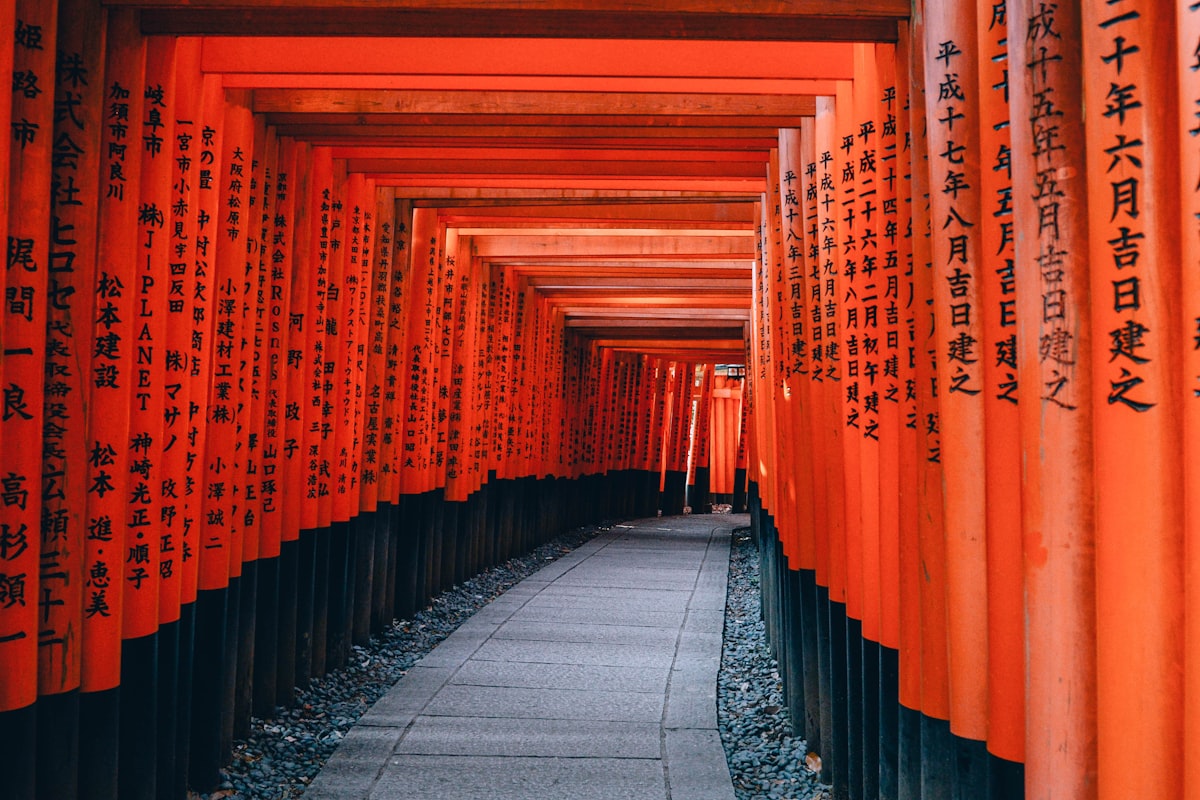
- Fushimi Inari (Kyoto) — 10,000 torii gates, founded in 711 AD
The Age of Samurai (1185 - 1603)
Kamakura Period (1185 - 1333) — Warriors Take Power
The samurai warrior class overthrew the aristocratic court and established military government (shogunate) in Kamakura. Japan became a warrior society — and the samurai code of honor, discipline, and loyalty still influences Japanese corporate culture today.
What it created:
- Bushido (武士道) — The way of the warrior. Loyalty, honor, self-discipline, and acceptance of death
- Zen Buddhism — Imported from China, it appealed to samurai for its emphasis on discipline and simplicity
- The Japanese sword (katana) — Perfected during this era. Still considered the finest bladed weapon ever made
Where to see it:
- Kamakura — The Great Buddha (Daibutsu), Zen temples (Engakuji, Kenchoji), and the seaside atmosphere of the first shogunate capital. Easy day trip from Tokyo
- Japanese Sword Museum (Tokyo) — Masterwork swords from this era
Muromachi Period (1336 - 1573) — Culture from Chaos
Despite constant civil war, this era produced some of Japan’s most refined cultural achievements:
- Noh theater — The world’s oldest surviving theatrical art form
- Tea ceremony (茶道) — Developed by Zen monks, perfected into an art of mindfulness
- Ink painting — Influenced by Chinese Zen art
- Kinkakuji and Ginkakuji — The Gold and Silver Pavilions of Kyoto
- Zen rock gardens — Ryoanji’s 15 stones on white gravel
Where to see it:
- Kinkakuji (Kyoto) — The Gold Pavilion
- Ryoanji (Kyoto) — The most famous Zen rock garden
- Ginkakuji (Kyoto) — The Silver Pavilion (never actually covered in silver)
Sengoku Period (1467 - 1615) — The Age of Civil War
Japan shattered into hundreds of warring states, each controlled by a feudal lord (daimyo). Three great unifiers emerged:
- Oda Nobunaga — The ruthless innovator who used firearms (imported from Portugal) to conquer central Japan
- Toyotomi Hideyoshi — The peasant who became ruler. Unified Japan through cunning and force
- Tokugawa Ieyasu — The patient strategist who won the final battle and established 260 years of peace
Where to see it:
- Nagoya Castle — Nobunaga’s power base
- Osaka Castle — Hideyoshi’s fortress (reconstructed, with excellent museum inside)
- Sekigahara (Gifu) — The battlefield where Ieyasu won Japan in 1600. Walking the actual battlefield is powerful
- Himeji Castle — Japan’s most beautiful original castle, surviving from this era. UNESCO World Heritage
Edo Period (1603 - 1868) — 260 Years of Peace and Isolation
What Happened
Tokugawa Ieyasu established the shogunate in Edo (modern Tokyo) and closed Japan to the outside world for over 200 years (sakoku — 鎖国, “closed country”). Only a tiny Dutch trading post in Nagasaki maintained contact with the West.
What Isolation Created
With no foreign wars and no foreign influence, Japan turned inward and developed an extraordinary culture:
- Ukiyo-e (浮世絵) — Woodblock prints depicting the “floating world” of pleasure, nature, and daily life. Hokusai’s Great Wave and Hiroshige’s landscapes later inspired Impressionism in Europe
- Kabuki (歌舞伎) — Dramatic theater with elaborate costumes and makeup
- Geisha (芸者) — Professional entertainers trained in music, dance, and conversation
- Sushi — Originated in Edo as a fast food for busy workers
- The class system — Samurai, farmers, artisans, merchants. Rigid but stable
- Castle towns — Every daimyo built a castle surrounded by a town. Many modern Japanese cities began as castle towns
- Sankin-kotai — Lords were required to travel to Edo every other year, creating Japan’s road network, inn system, and travel culture
The Legacy
The Edo period is why Japan feels so culturally rich. 260 years of peace gave the Japanese time to perfect their crafts, refine their arts, and develop the social systems that still operate today. The politeness, the hierarchy, the craftsmanship, the food culture — all of it was polished during this long peace.
Where to see it:
- Tokyo — Edo was renamed Tokyo in 1868. The Imperial Palace sits on the Edo Castle grounds
- Nikko — Toshogu Shrine, the elaborate mausoleum of Tokugawa Ieyasu
- Kanazawa — One of the best-preserved castle towns. Kenrokuen Garden, samurai district, geisha district
- Takayama — Edo-period streets preserved almost intact
- Ouchijuku (Fukushima) — A thatched-roof post town frozen in time
- Kawagoe — “Little Edo,” with preserved warehouse district near Tokyo
Meiji Restoration and Modernization (1868 - 1945)
The Shock of Opening
In 1853, American Commodore Perry arrived with warships and forced Japan to open its ports. The shock was existential — Japan realized it was centuries behind the West in military technology. The response was extraordinary:
The Meiji Revolution
The samurai class overthrew the shogunate, restored the Emperor to power, and launched the most rapid modernization in human history:
- 1868: Feudal system abolished
- 1872: First railway (Tokyo-Yokohama)
- 1889: Constitution adopted
- 1895: Defeated China in war
- 1905: Defeated Russia — the first Asian nation to defeat a European power
- 1912: A feudal country became a modern industrial power in 44 years
The philosophy: “和魂洋才” (wakon yousai) — “Japanese spirit, Western technology.” Japan adopted Western systems (railways, factories, military, education) while consciously preserving Japanese culture. This is why modern Japan feels like two civilizations layered on top of each other — because it is.
Where to see it:
- Meiji Shrine (Tokyo) — Dedicated to Emperor Meiji, in a forest of 100,000 trees
- Tokyo Station — The red-brick Marunouchi building, designed in European style during the Meiji era
- Yokohama — Japan’s first port opened to the West. The Minato Mirai waterfront
World War II and the Atomic Bombs
Japan’s imperial expansion led to devastating war. The atomic bombings of Hiroshima (August 6, 1945) and Nagasaki (August 9, 1945) brought Japan’s surrender and a national trauma that permanently shaped the country’s identity.
Where to see it:
- Hiroshima Peace Memorial Park — The A-Bomb Dome, the museum, and the Children’s Peace Monument. Essential, devastating, and hopeful
- Nagasaki Peace Park — The second bombing site. Quieter, equally moving
Post-War Miracle to Modern Japan (1945 - Present)
The Economic Miracle
From the ashes of war, Japan rebuilt itself into the world’s second-largest economy in just 30 years. The same discipline, group cooperation, and perfectionism that created samurai culture now built Toyota, Sony, Honda, and Nintendo.
What Postwar Japan Created
- Bullet train (1964) — The Shinkansen symbolized Japan’s rebirth
- Anime and manga — From Astro Boy (1963) to a global cultural force
- Video games — Nintendo, Sony PlayStation, Sega — Japan defined the industry
- Convenience culture — Konbini, vending machines, automated everything
- Fashion — From Issey Miyake to Harajuku street style
- Food innovation — Instant ramen (1958), conveyor belt sushi (1958), the refinement of every cuisine
Modern Challenges
- Population decline — Japan’s population is shrinking and aging. Rural areas are emptying
- Economic stagnation — The “Lost Decades” after the 1990s bubble burst
- Balancing tradition and change — How to modernize while preserving identity
- Tourism boom — Record visitors creating new opportunities and challenges
Where to see modern Japan:
- Shibuya Crossing (Tokyo) — The chaotic, vibrant modern city
- Akihabara (Tokyo) — Anime, gaming, electronics — pop culture capital
- Osaka — The energy, the food, the humor of modern Japan
The Thread That Connects Everything
Every period of Japanese history left a visible layer that you can still experience today:
| Historical Layer | What You See Today |
|---|---|
| Jomon (10,000 years ago) | Shinto reverence for nature at every shrine |
| Yayoi rice culture | Rice at every meal, sake at every celebration |
| Nara Buddhism | Every temple you visit |
| Heian aesthetics | Kyoto’s beauty, seasonal awareness, tea ceremony |
| Samurai discipline | Punctuality, hierarchy, dedication to craft |
| Edo isolation | Unique culture, craftsmanship, ukiyo-e, sushi |
| Meiji modernization | Trains, schools, the blend of old and new |
| Post-war innovation | Shinkansen, anime, konbini, technology |
Japan is not a country where history happened in the past. It is a country where every era of history is still happening — simultaneously, in the same city, sometimes on the same street. A Shinto shrine from 1,000 years ago sits next to a 7-Eleven. A kimono-clad woman walks past a cosplayer. A 400-year-old tea house serves matcha beside a vending machine selling corn soup.
This is not contradiction. This is Japan. And now that you understand why, every shrine gate, every bowing stranger, and every grain of rice will mean something more.