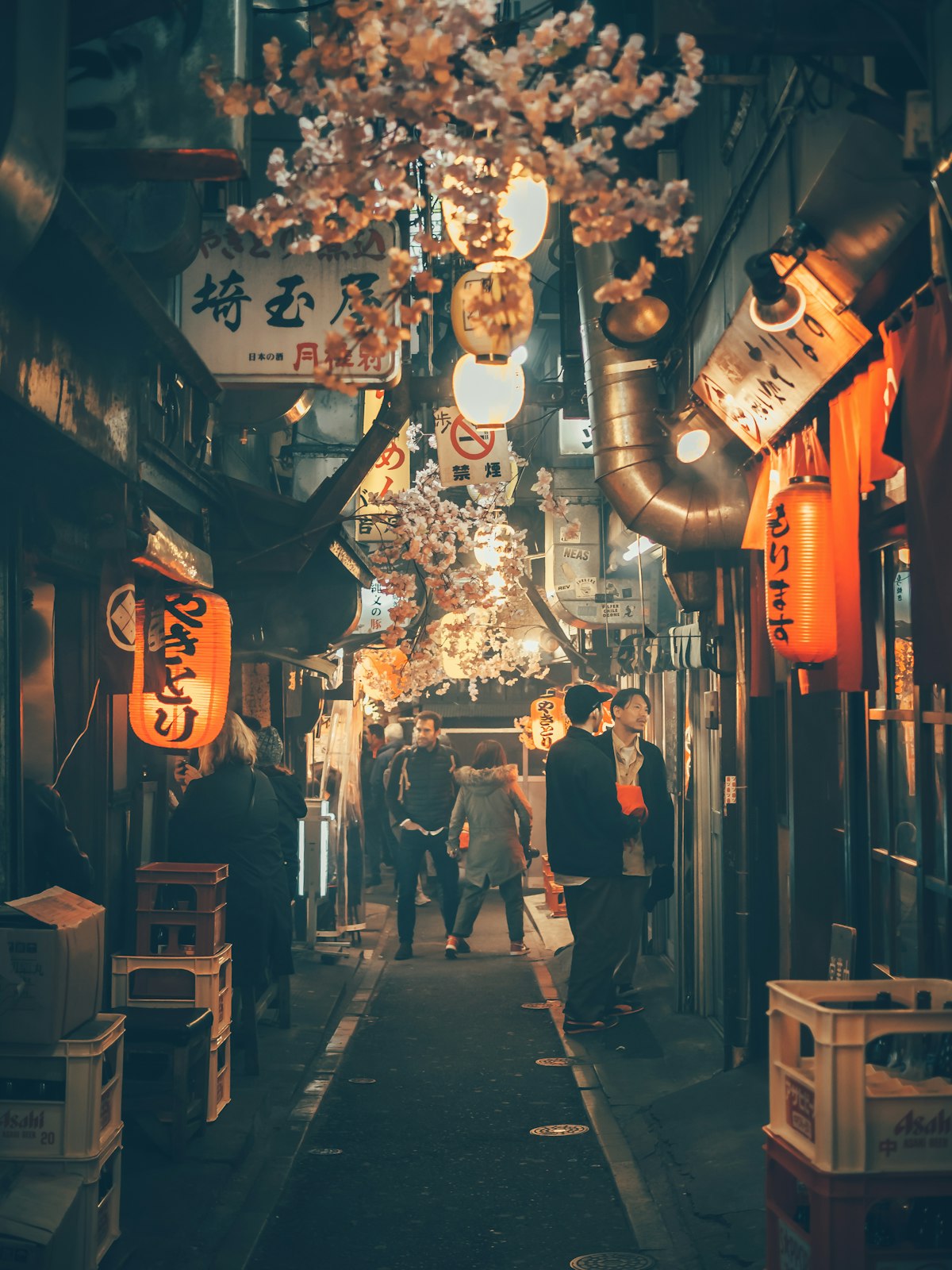
Drinking is central to Japanese social life. The office worker who is formal and reserved during the day becomes warm, open, and honest after a few drinks at the izakaya. This transformation is not just tolerated — it is expected. Understanding drinking culture is understanding how Japanese people actually connect with each other.
Types of Drinking Establishments
Izakaya (居酒屋) — The Essential Experience
What: A casual Japanese pub-restaurant. The default after-work destination for most Japanese people. Atmosphere: Lively, noisy, social. The exact opposite of the quiet daytime. Price: ¥2,000-4,000 per person (food + drinks)
How it works:
- Enter and say how many people (hitori = 1, futari = 2)
- Seated at a table or counter
- Otoshi (お通し): A small appetizer automatically served (¥300-500 cover charge). This is not optional — it is the table charge
- Order drinks first — “Toriaezu biiru!” (とりあえずビール! — “Beer first!” — the universal opening line)
- Order food gradually throughout the evening. Dishes are shared
- Order more drinks as you go
- Ask for the check: “Okaikei onegai shimasu”
Best chains for tourists:
- Torikizoku (鳥貴族) — All items ¥350. Yakitori specialist. Unbeatable value
- Watami (和民) — Large chain, English menu at some locations
- Ippudo — Yes, the ramen chain has izakaya-style locations
- Local independent izakaya — The best experience. Look for places with red lanterns (赤提灯 — aka-chochin) outside
Tachinomi (立ち飲み) — Standing Bars
What: Stand-up drinking bars. No seats — everyone stands at the counter or high tables. Price: ¥1,000-2,000 per person. The cheapest drinking option. Where: Under train tracks (Yurakucho, Shinbashi), in shopping streets, near stations Why go: Incredibly cheap (beer from ¥200, snacks from ¥100), social (easy to talk to strangers), and authentically Japanese
Best areas:
- Yurakucho/Shinbashi under the tracks — dozens of tiny tachinomi
- Ueno Ameyoko — market-area standing bars
- Tenma (天満) — Osaka’s tachinomi paradise
Yokocho (横丁) — Alley Bars
What: Narrow alleys packed with tiny bars, each seating 6-10 people. Atmosphere: Intimate, smoky (sometimes), nostalgic. Each bar has its own personality.
Famous yokocho:
- Golden Gai (ゴールデン街) — Shinjuku. 200+ tiny bars in 6 narrow alleys. Many have cover charges (¥500-1,000) and some are regulars-only. Look for “Welcome” or “Tourist OK” signs
- Omoide Yokocho (思い出横丁) — Shinjuku. Yakitori and ramen bars under the train tracks. Smoky, atmospheric, incredible
- Nonbei Yokocho (のんべい横丁) — Shibuya. Tiny, hidden behind the station
- Hoppy Street (ホッピー通り) — Asakusa. Budget drinking next to Senso-ji
Snack Bar (スナック)
What: Small bars with a mama-san (female owner) who serves drinks, sings karaoke, and makes conversation. A uniquely Japanese social institution, especially in rural areas. Price: ¥3,000-5,000 (set charge + drinks) Note: Mostly Japanese-language only. Welcoming but can be awkward without Japanese ability. Best experienced with a Japanese friend.
Bars (バー)
What: Western-style cocktail bars and whisky bars. Price: ¥1,000-3,000 per drink Famous: Hotel bars (Park Hyatt “New York Bar” from Lost in Translation), Ginza cocktail bars, Shibuya/Shinjuku bar districts
Craft Beer Bars
See our dedicated Japanese Beer guide.
The Nomikai (飲み会) — Group Drinking
What It Is
An organized group drinking event — usually with colleagues, classmates, or friends. The nomikai is where real bonding happens in Japan.
Nomihodai (飲み放題) — All-You-Can-Drink
Most izakaya offer nomihodai plans:
- Price: ¥1,500-2,500 for 2 hours
- Includes: Beer, chuhai, highball, sake, shochu, soft drinks
- Food: Often combined with tabehodai (all-you-can-eat) for ¥3,000-5,000
- Time limit: Usually 90 minutes or 2 hours. Last order 30 minutes before end
Nomikai Rules
- The first drink is beer — Always. Order whatever you want after
- Wait for kanpai — Do not drink before the group toast
- Pour for others — Never pour your own drink in a group
- The most junior person sits nearest the door and pours drinks
- “Ikki! Ikki!” — If someone chants this, they want you to chug. You can decline (and should if you want to)
- Nomunication — A portmanteau of “nomu” (drink) and “communication.” This is the concept that drinking together builds relationships. Your boss, who is formal all day, may become your drinking buddy at night
Drinking Etiquette
Universal Rules
- Kanpai before first drink — Always
- Pour for others — Especially for seniors and your companions
- Hold your glass with both hands when someone pours for you
- Never refuse the first drink — Even if you don’t drink alcohol, accept a soft drink for the kanpai
- It’s OK to get drunk — Japanese drinking culture is forgiving. Being tipsy is expected. Being out-of-control is not
What NOT to Do
- Don’t pour your own drink in a group setting
- Don’t start drinking before kanpai
- Don’t pressure non-drinkers — “I don’t drink” is increasingly accepted, especially among younger Japanese
- Don’t get aggressive — Happy drunk is fine. Aggressive drunk is never acceptable
Non-Drinkers
If you don’t drink alcohol:
- Order oolong tea (ウーロン茶) — the standard non-alcoholic izakaya drink
- Soft drinks, ginger ale, and non-alcoholic beer are always available
- Nobody will pressure you beyond the initial surprise. Just say “osake wa chotto…” (お酒はちょっと… — alcohol is a bit…)
What to Eat While Drinking
See our dedicated Otsumami guide for the complete list, but the essential izakaya order:
First round (with beer):
- Edamame (枝豆) — ¥300
- Karaage fried chicken (唐揚げ) — ¥500
Second round (with sake/shochu):
- Yakitori assortment (焼き鳥盛り合わせ) — ¥800
- Sashimi plate (刺身盛り) — ¥1,000
Late round (getting full):
- Ochazuke (お茶漬け) — Rice with tea poured over. The classic “closing dish”
- Onigiri (おにぎり) — Simple rice balls to settle the stomach
After Drinking
The Last Train Problem
Most trains stop between 23:30-00:30. Missing the last train is a rite of passage in Japan.
Options if you miss it:
- Taxi — Expensive (¥3,000-10,000 depending on distance). Share with others going the same direction
- Karaoke — Rent a room until the first train (5:00 AM). ¥1,500-2,500 for the night package
- Manga cafe — Sleep in a reclining chair booth. ¥1,500-2,500
- Capsule hotel — If you can find one with vacancy. ¥3,000-5,000
- McDonald’s / Denny’s — Open 24 hours. Coffee and wait
- Walk — Some people walk 1-2 hours home. Google Maps will guide you
Hangover Solutions (二日酔い対策)
Japanese convenience stores sell everything you need:
- Ukon no Chikara (ウコンの力) — Turmeric drink. Take BEFORE drinking. ¥200
- Hepalyse (ヘパリーゼ) — Liver support drink. ¥300
- Pocari Sweat — Electrolyte replacement. Essential morning-after
- Ochazuke — Green tea over rice. The gentlest morning-after meal
- Shijimi miso soup — Clam miso soup. Traditional hangover cure
Budget Drinking Guide
| Option | Cost/Evening | Experience |
|---|---|---|
| Convenience store + park | ¥500-1,000 | Buy cans, drink at a park or riverbank. Very common in Japan |
| Tachinomi | ¥1,000-2,000 | Standing bar, cheap snacks |
| Chain izakaya (Torikizoku) | ¥2,000-3,000 | All items ¥350, good quality |
| Nomihodai at izakaya | ¥2,500-4,000 | All-you-can-drink + food |
| Independent izakaya | ¥3,000-5,000 | Best food and atmosphere |
| Golden Gai / Yokocho | ¥2,000-4,000 | Unique atmosphere, cover charge |
| Hotel bar | ¥5,000-10,000 | Views, cocktails, luxury |